Search the NET a you will find an incredible amount of these sensor size comparison graphics so why in the world have I created yet another? Asking myself that very question I came up with or the story I'm going to go with, it gave me an excuse to play 'photo-editor' and as they say "practice (or perfect practice) makes perfect". The result, here is what I came up with. The small graphic under index, just above The Muse's URL is an approximation or near to the actual size of each sensor.
'The Money Shot' was shot at f/57 the maximum f-stop at 1:1 for this lens therefor some detail (sharpness) would certainly be lost due to Lens Diffraction. This sample would indeed have been a little sharper if shot with a wider aperture. However for these first samples I wanted show this lenses best depth-of-field.
More
Update: March 12, 2015
Kalanchoe(WiKi) also written Kalanchöe or Kalanchoë, is a genus of about 125 species of tropical, succulent flowering plants in the family Crassulaceae, mainly native to the Old World. Only one species of this genus originates from the Americas, 56 from southern and eastern Africa and 60 species in Madagascar. It is also found in south-eastern Asia until China.
A few days I decided to buy the WACOM Intuos5 touch Small (PTH450M). Pen Tablet hardware that will be used in my photo-editing.
Update: The new Pen and Tablet arrived.
After trying the device for the first time, first impressions left me thinking that learning to use it is going to be challenging. This is only because I have near 30 years of mouse experience to rewrite. Learning certainly will take allot of time and practice (actually, perfect practice) to retrain my muscle memory to become proficient with the Pen. Regardless this is wonderful technology and I'm looking forward to what I might accomplish with the new toy ...
My workspace showing the new tablet and it's also the first image edited with the new hardware.
Related:
Graphic Tablets: A good tutorial site that exclusively uses Pen Tablets. This would be a great place to start learning to use a tablet for the first time.
From the time I first got into photography back in my day of analog (film) there was one lens I craved and this was a great MACRO but for one reason or another it was a lens I never got around to buying. And four years passed since buying my first DSLR (Nikon D90, which was my fourth digital camera) I was still wishing for a great MACRO lens. A prime macro/telephoto lens to compliment my swiss army knife lens, my Nikkor 16-85mm 1:3.5-5.6 DX. I'm happy and exited to say today is the red letter day (WiKi) I had dreamt about for all the years past. I've purchased the following, my "dream" glass, a prime telephoto, a true 1:1 MACRO Lens which comes highly praised by pro reviews and user reviewers alike.
Salient Specifications:
Format: FX/35mm
Focal Length: 105mm FX (Full Frame) 158mm equivalent DX (APS-C)
Maximum Aperture: f/2.8
Minimum Aperture: f/32
Maximum Reproduction Ratio: 1.0x
VR (Vibration Reduction) Image Stabilization: Yes
Autofocus: Yes, AF-S (Silent Wave Motor)
Internal Focusing: Yes
Minimum Focus: 1.0 ft. (0.314m)
Filter Size: 62mm
Dimensions: (Approximate) 3.3 x 4.6 in. (D x L) / 83 x 116mm (D x L)
Nikon D90 with it's DX (APS-C) sensor and zoom lens set at 85mm, 100% Crop. I might NOT need that NEW and expensive large focal length telephoto I was eyeballing. Well, there is a difference between needing and wanting, I want!
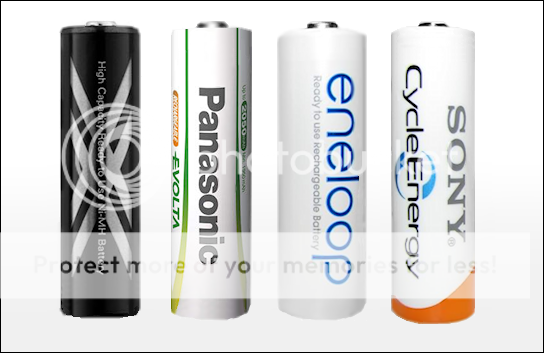
Low Self Discharge (LSD) are an improved type of NiMH rechargeable battery introduced in 2005 and are the only type of battery I will use. Here's why, given the self discharge rate of conventional NiMH Batteries (let's call them old tech) being unacceptable I've found the following brands will meet my needs. Therefor needing batteries that are ready to go at a moments notice I found on average LSDs will have a longer shelf life as they will retain most of their stored capacity by year end giving approximately 1500 re-charge cycles or more. The 'eneloop' brand are claimed to hold their charge for 5 years with 1,800 cycles. LSD rechargables are also available in Triple-A (AAA) sizes.
According to a battery tutorial from photo tuts+ "Conventional NiMH batteries at the approximate capacity loss of 10% after the first 24hrs and 1% per day after will loose just over ½ of their capacity by month's end." This is why Conventional NiMH rechargeable batteries are unsuitable for powering clocks, TV remotes or any device where it's batteries are expected to last a long time. Conventional (old tech) NiMH rechargeable batteries simply self-drain too fast.
Quote: Low Self Discharge (Wikipedia) NiMH are "a new type of nickel–metal hydride cell (the low self-discharge nickel-metal hydride battery, LSD NiMH) was introduced in 2005 that reduces self-discharge and therefore lengthens shelf life. By using an improved electrode separator and improved positive electrode, manufacturers claim the cells retain 70% to 85% of their capacity after one year when stored at 20 °C (68 °F). These cells are marketed as "hybrid", "ready-to-use" or "pre-charged" rechargeables. Standard NiMH batteries may lose half their charge in the same time period. Retention of charge depends a lot on the battery's impedance or internal resistance (the lower the better), and on the size of the battery as well as the mAh rating. Besides the longer shelf life, they are otherwise similar to traditional NiMH batteries of equivalent capacity and can be charged in typical NiMH chargers"
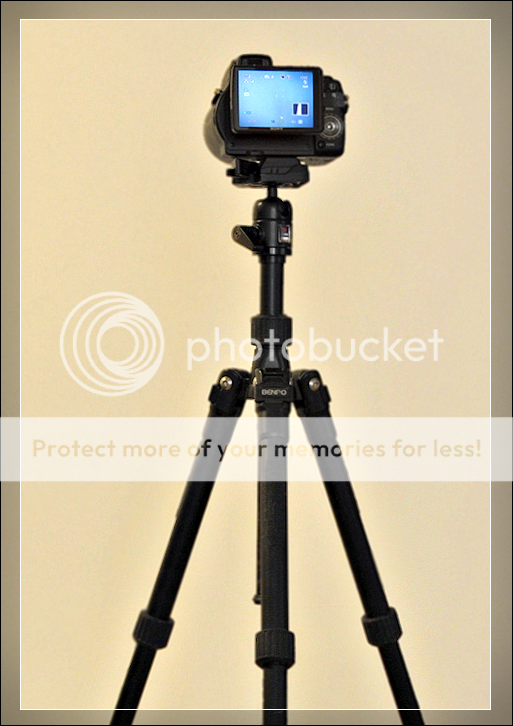
It was one of those times buying my Tripod on-sale might not have been a good idea. Only after purchasing did I discover this particular Tripod had been discontinued and much to my disappointment extra Quick Release Plates or QR-Plates (Fig 1) we're unavailable.
Needing an extra QR-Plate but never to be beaten into submission by those who would suck me dry of my cash I decided to reverse engineer the part by putting my DIY (do-it-yourself) skills to the task but this was not what was going to happen.
Following is my short story of what was supposed to be a DIY project instead turned into the creation and the reverse engineering of a part by professional and skilled CNC Machinists.
Copying the QR-Plate: My measurements
Fig 1: QR-Plate being copied
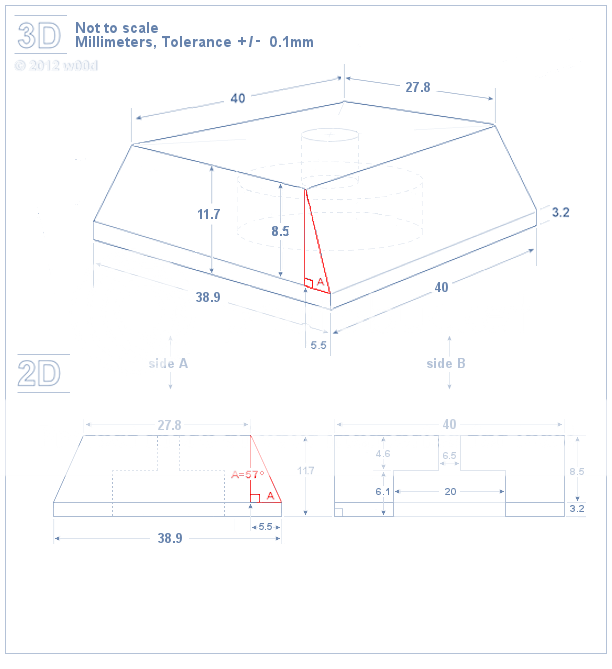
Fig 2: QR-Plate measurements
I wanted to make the new QR-Plate myself and given some materials, time, a Dremel with a few hand tools this was certainly possible. But it was then I realized I have some great friends over at Southern Oregon RC (SORC) who have CNC Machinery therefor they might be tasked to do the work for me, if of course asked very nicely? A skilled CNC operator and his CNC Milling Machine would certainly do a much better, a more professional job than could be done with ordinary hand tools of this hobbyist.
So the next order of business was to ask my good friends if they would be willing to make the part and would they quote me a price if they we're agreeable. They said yes although they didn't give me a price, both friends Tiger and Pelagic Pilot unbeknownst to myself simply got to work making the part.
(Fig 3 and 4)The first CNC Tripod Quick Release produced is made out of aluminum and was fabricated with his CNC Machine by my good friend Tiger (SORC) who is an accomplished engineer. The surprise coming out of this story was him asking me for the angles of two sides of the item I needed cut. At this time he went silent for a few days which left me somewhat puzzled as I thought maybe he had simply forgotten about me. However this was not the case because the next thing I knew much to my delight was a couple of photo's of the finished product and Tiger asking for my shipping address, surprise indeed!
(Fig 5 and 6) The next example is made out of Delrin Acetyl (plastic) and was created by another good friend Pelagic Pilot (SORC) who also runs his own CNC business, BlueFin CNC LLC. From what I could tell given I'm no CNC expert there's quite allot of work between my measurements and the actual cutting of the piece. As I understand Tyson transferred my measurements I had drawn up within a simple photo-editor into his CAD program (Alibre CAD) which creates a .STL file which is then exported into another application (MeshCam). Now armed with the .STL data MeshCam can now creates the necessary 'toolpath' or the path the cutting tool will travel while cutting. Alibre and MeshCam screenshots for those interested.
It's good to have good friends
It's GREAT to have such friends especially when they have the skills and machines to do such wonderful work. Both Tiger and Pelagic Pilot put allot their talent, their time and even their own money into making my project come alive which is certainly appreciated. I don't have enough words to express my gratitude except to say, GREAT job guys, thank you, the world is a better place for having you guys! Yes I'm very excited and can't wait to try them out but now I'm only waiting for the postman ...
It will be interesting to see how the two materials, the aluminum verses the Delrin Acetyl compare. For example the plastic (Delrin Acetyl) will certainly be the lighter of the two materials but the aluminum version might prove more durable?
FYI: So what is a Tripod Quick Release Plate (QR-Plate) you might ask? If your not a photographer or looking to get into photography or you're just curious it's a reasonable question. QR-Plates basically allows for quick mounting and dismounting of a camera onto and from a typical tripod. None of which are standardized as they come in all shapes and sizes all with varying costs to match. Google: Tripod Quick Releases.
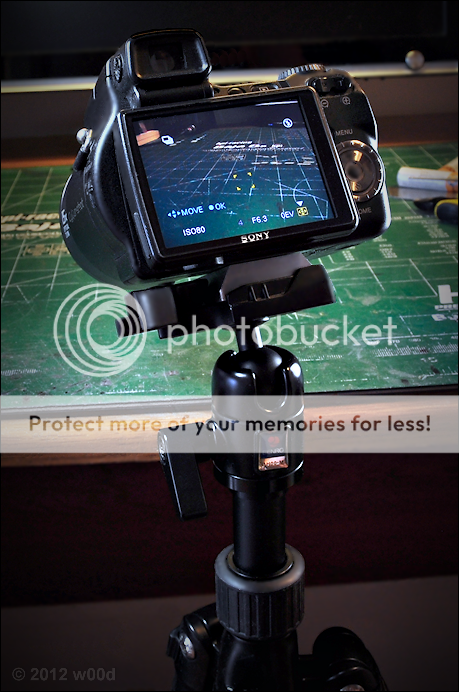
Fig 7: Nikon D90 attached
Fig 9: QR-Plate inserted into the locking mechanism